
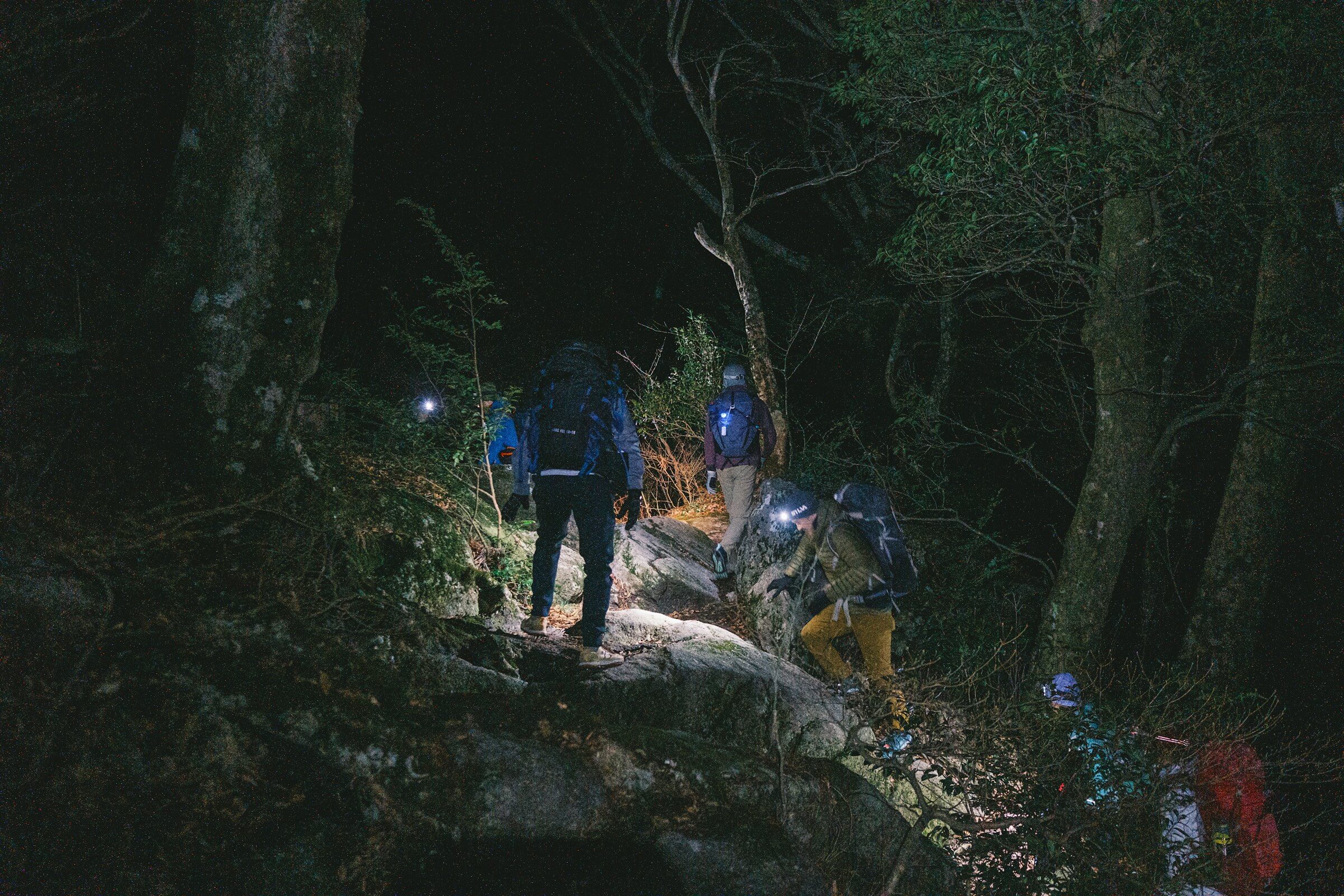

Hiking at night: why walking under the stars is a good idea
Hardly anyone walks at night – what a thought! And yet, the same daytime trail becomes a totally different experience once the sun goes down. Amplified sounds, stars everywhere, heightened senses: night transforms everything. We explain why it’s so worth it, and how to get started without the stress.
You’ve got the idea in your head: a priori, we walk during the day and sleep at night. It’s logical, that’s the way it’s always been. And why walk at night if you can’t see the landscape? Result: most people have never tried it. They know their favourite trails by heart, but only the daytime version – the night-time version remains unexplored.
But walking at night isn’t just about walking in the dark. It’s about discovering nature in a different way, with new sensations, a completely different relationship to the body and to space. But before you dive in, you need to understand why you don’t dare.
Why we don’t dare hike at night
Fear of the dark is ancestral, engraved in our genes. Night = inability to see predators and other threats = danger. This survival reflex has enabled the human species to survive until now. But today, in France, on a marked trail in the Alpes Mancelles, this reflex is more like an irrational brake.
First, there’s the fear of getting lost. Without visual landmarks, you imagine you’re going to go round in circles, miss a junction, end up in the middle of nowhere. But trail markings don’t disappear in the middle of the night. Reflective markings are often more visible with a headlamp than paintwork in bright sunlight! And with a good navigation app and a well-charged phone, it’s hard to get really lost.
Then there’s the fear of unpleasant encounters. First of all, remember that animals, day or night, flee at the sound of footsteps. They’re more afraid of you than you are of them. And what about humans? Can you imagine a horror movie scenario in which you’re running through the woods with someone on your tail? Statistically, hiking trails are among the safest places in the country !
In fact, over 12,000 French communes have switched off their public lighting at night in recent years. Everyone predicted an explosion in crime as a result. The result: there has been no increase, and burglaries have even fallen in some communes. Why is this? Because an attacker looks for density, urban anonymity and a quick escape route. Not an isolated path in the middle of the forest, where he’s likely to come across three hikers with their headlamps on! The (very) few people you come across will probably be there for the same reasons as you: experience and peace and quiet.
In short, the night adds the unknown. And the unknown is scary, even when it shouldn’t be. At the Bon Air Club, we campaign to transform fear of the unknown into curiosity and the desire to try out new experiences. The famous “get out of your comfort zone” can also take the form of a night hike. And believe us, you’ve got a lot to gain.
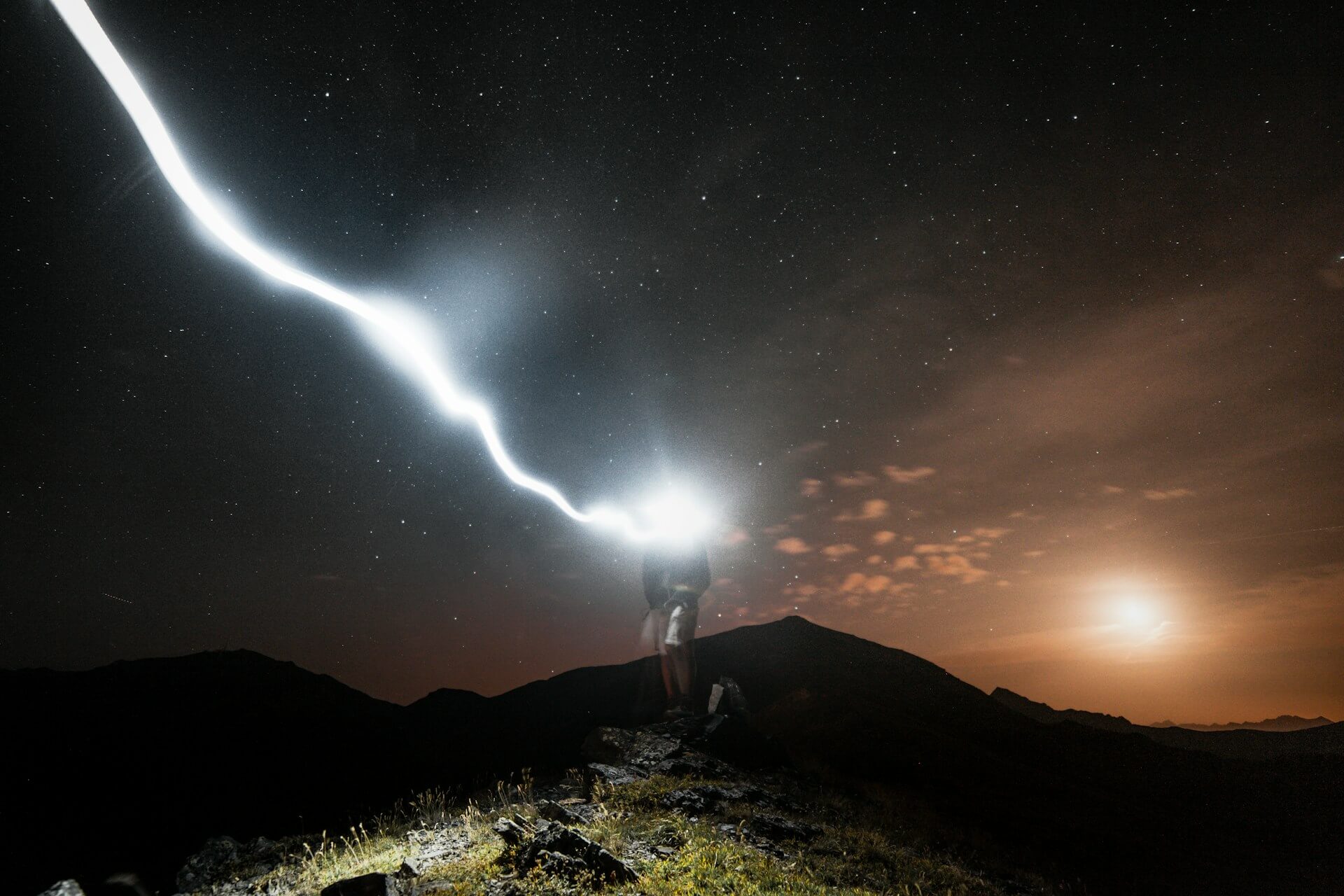
Photo : Unsplash
What the night really changes
- We hear better at night
That’s the first thing you notice. The ambient noise has disappeared (cars, conversations, daytime birds). A branch creaking 50 meters away can be heard as if it were next door. A stream becomes deafening. The wind in the leaves takes on a new amplitude. The reason? Air, which is denser at night, conducts sound better.
It’s also because our auditory senses compensate for the lack of vision. Just as a blind person develops a finer sense of hearing – our brain, deprived of visual information, boosts hearing to compensate. We pick up nuances that we never notice during the day. The sound of an animal moving through fallen leaves, an owl hooting in the distance, even our own breathing becomes audible.
- Odors explode
Same mechanism. When sight fails, smell takes over. It’s an ancestral survival reflex: to detect danger, a source of water or food. On a night hike, you can smell everything. Humus, damp moss, mushrooms, tree sap. The air is also more charged, thanks to the dew that forms: the water in the air better captures and transports odor molecules. These odors exist during the day, but are barely noticeable. At night, they are almost intoxicating.
- Eyes adapt
After 20 to 30 minutes in the dark, night vision kicks in. The retinal rods, sensitive to low light intensity, take over from the cones (daytime vision). We can no longer see colors, but we can distinguish shapes, contrasts and movements. Once this adaptation has been made, we can even walk without a headlamp on a full-moon night. So our eyes have two modes of operation: pretty cool, don’t you think?
- A starry sky like never before
In France, 80% of the night sky is polluted by artificial light. In the city, you can barely see a few stars. In the Alpes Mancelles, far from any source of light, the opposite is true. To look up at the sky is to discover thousands of stars, the Milky Way, the constellations… An increasingly rare spectacle, but as breathtaking as ever for us little humans. We feel small, connected to something bigger. It’s no coincidence that some cultures practice night-walking as a form of meditation.
- Nocturnal animals come out
Deer, foxes, badgers, wild boar: they live mainly at night, moving, hunting, exploring. On a night hike, there’s every chance you’ll come across them. Not necessarily of seeing them (they often flee at noise), but of hearing them and guessing their presence. If you’ve ever heard an owl hoot at night in the middle of the woods, you’ll remember. A mystical atmosphere.
- Cold awakens
Attention, revelation: the temperature drops at night, even in summer. The air becomes crisp, prickly. You can feel the cold on your cheeks and hands. This contrast with the heat of the day wakes the body and keeps you alert. There’s no need for coffee: the freshness is enough to keep your mind clear, to make you more present. It’s also a great alternative to a hot summer hike! And when you come home after an hour out in the cold at night, hot herbal tea really comes into its own.
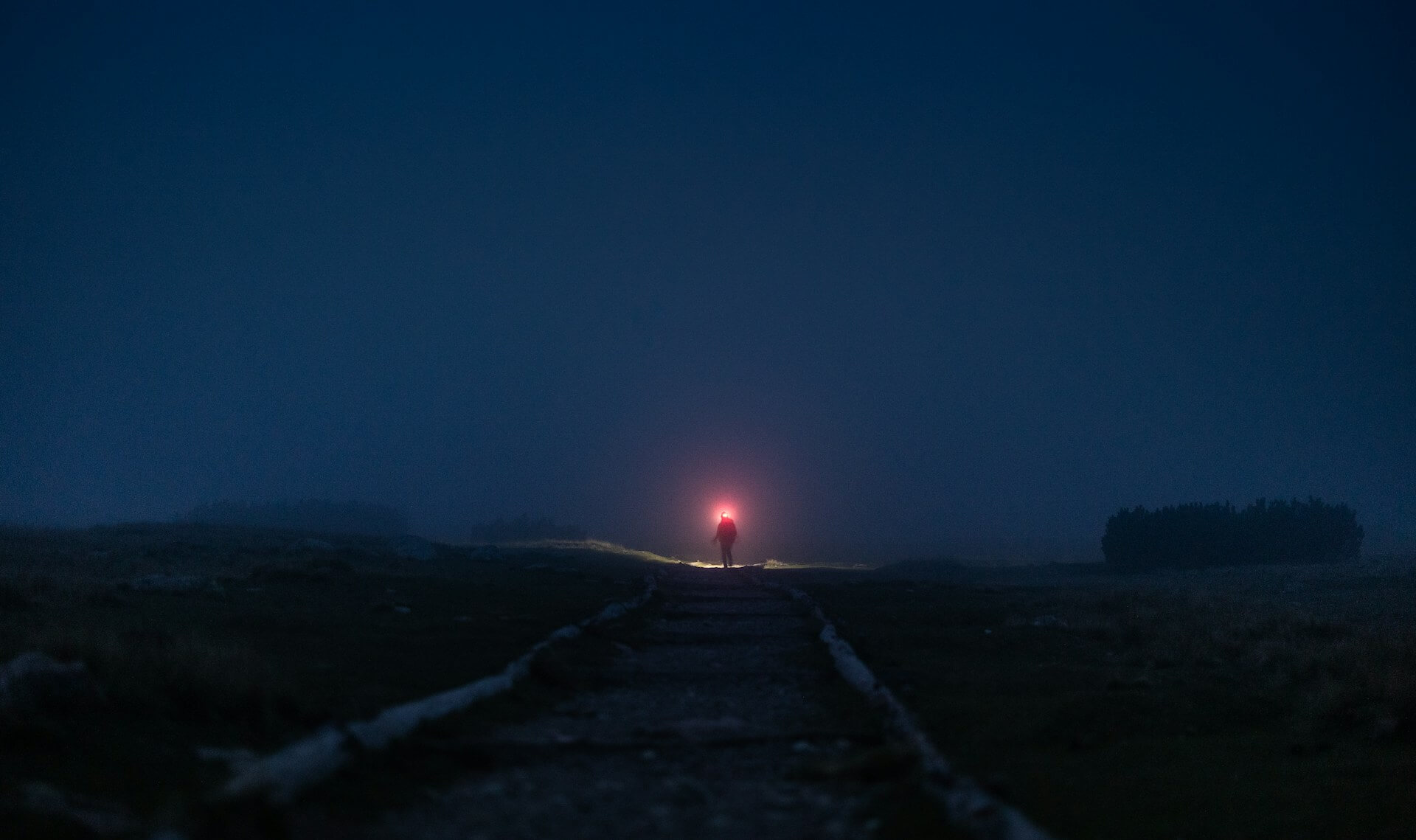
Photo : Unsplash
How to get started without stress
- Start small
There’s no need to set off on a three-hour hike the first time. A one-hour loop on a trail you’ve already ridden during the day is more than enough. The aim is to try it out, see what it feels like and get used to the sensations. Once you’ve figured out that it’s not that impressive, you can extend it.
- Going in a group
Solo, the night can seem more intimidating. With several people, it’s different. We reassure each other, share impressions, laugh about little scares, strange shapes in the trees and “what was that”? It makes the walk lighter, and it’s always safer in case something goes wrong.
- Taking advantage of the full moon
For your first night hike, choose a night with a full moon: it’s as clear as day – or almost. You can even turn off your headlamp at times! It’s unsettling at first, then magical.
- Minimum equipment
A headlamp, then (with spare batteries or battery max), a warm jacket, a charged phone. That’s all there is to it. No need for ultra-sophisticated GPS, no need for survival gear. Just something to see, something to keep out the cold, and something to call if there really is a problem.
Bon Air Club offers supervised night-time outings. A guide who knows the trails, a small group, a reassuring atmosphere. Alternatively, we offer safe itineraries that you can do on your own, with maps, advice and the certainty that you won’t get lost. It’s a reassuring way to start.
Night transforms everything
Walking at night is not a degraded version of day hiking. It’s a different experience. More sensory, more immersive and surprising. You discover that your senses work differently, that you don’t need to see everything to move forward, that the dark is not empty but full of sounds, smells and life.
Once you’ve tried it, you never see nature in the same way again. You realize that it exists at night too, that it doesn’t stop at sunset. And that anyone can enjoy it. No need to be an expert, no need for sophisticated equipment. Just get out, walk, listen.