
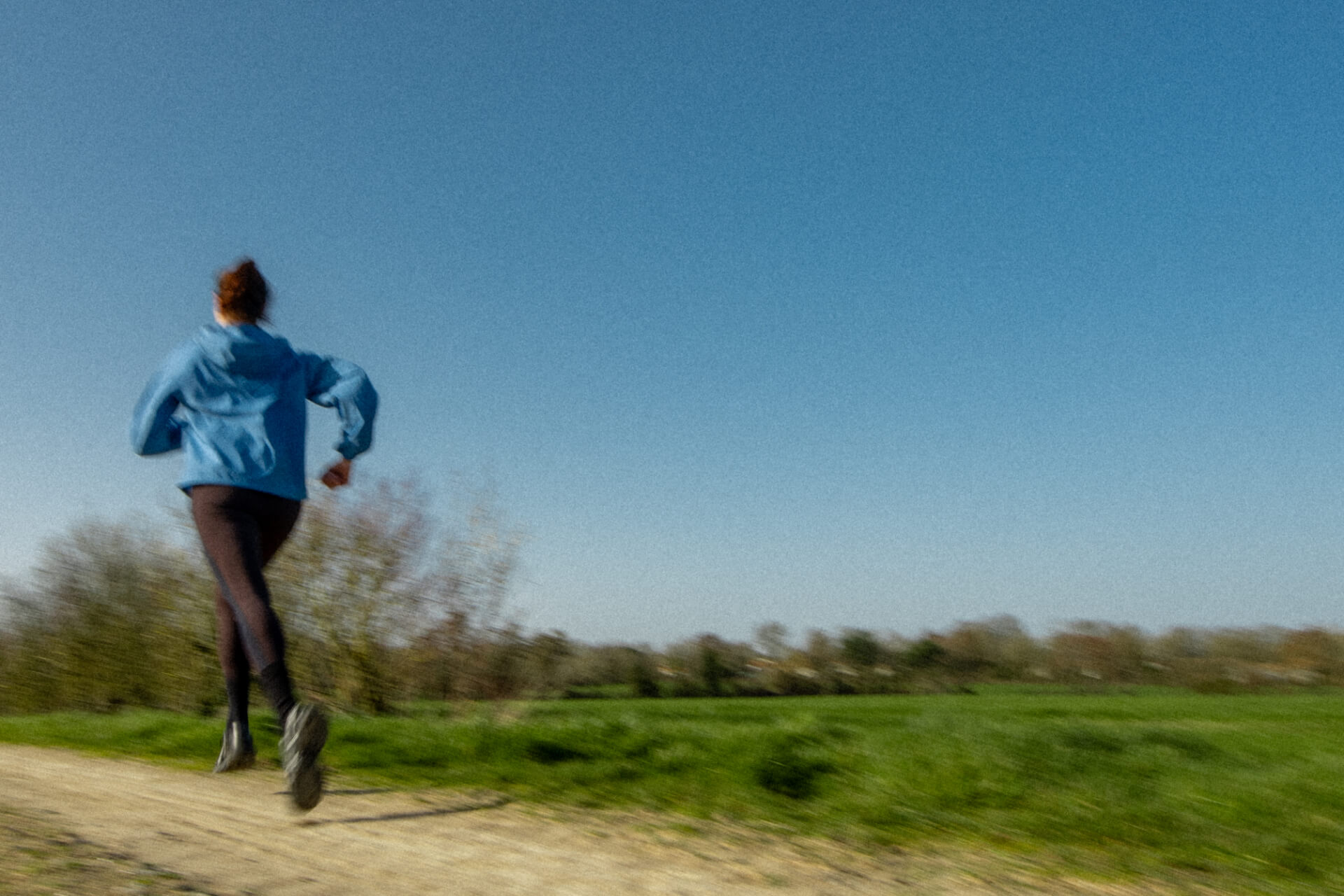

Why does a trail run in the wilderness provide more excitement than a 10km city run?
You’ve noticed: trail running is exploding all over France. And yet, the city remains the primary playground for runners. Why do so few trail runners dare to run in the great outdoors? Terrain, body, sensations: a trail run in the forest changes everything. We tell you why, and help you take the plunge.
Trail biking has exploded in France: +300% in ten years. The result? The stairs of Montmartre have become a crowded training ground, the quays of the Seine resemble a freeway at rush hour, and urban races like the Verticale de la Tour Eiffel sell out within hours. Paris now boasts over 15 urban trail events a year, compared with two or three ten years ago.
It’s easy to see why: it’s convenient to run in the city. No need for a car, no logistics, just get out and go – and trail event promoters are well aware that there’s a market for this kind of “trail, but on tarmac” practice. But something is missing. Anyone who has tried trail running in the great outdoors knows: running in the city and running in the forest are not the same sport. Neither for the body, nor for the head.
Living terrain vs. dead asphalt
Running on asphalt is like running on automatic pilot. The ground is flat, predictable, even (and hard, which is very bad for the joints!). The legs turn in a continuous rhythm. In nature, impossible. The terrain is constantly changing: outcropping roots, rolling pebbles, slippery mud, dry climbs, technical descents. Each stride requires instant adaptation. Over time, the body becomes more reactive, coordinated and precise.
Result: 30% more muscles are required for trail riding. All those little stabilizing muscles we forget about in the city come to life. Ankles are constantly working to adapt to uneven ground. The knees absorb shock differently with each stride. The hips compensate for imbalances, while the deep muscles of the trunk maintain stability. This is what we call proprioception: the body’s ability to position itself in space and react instantly to the terrain. On smooth asphalt, it sleeps. In nature, it’s on constant alert.
At the same speed, a trail run in nature burns 20 to 25% more calories than a flat urban run. The difference in altitude plays a part in this, of course, but so does the constant adaptation required of the body, which expends more energy to remain stable and efficient. This training is good for your muscles, your joints and your brain too! By managing the unexpected, the body also learns to avoid injury in the long term. Physiotherapists agree: varying your terrain protects your body.

Photo : Unsplash
The head really comes off
When you’re running in town, your brain is on high alert. Red lights, cars, bicycles, pedestrians, sidewalks, crossings: your attention is constantly required. Researchers call this “hard attention”, an active, energy-guzzling vigilance that tires the mind. In nature, everything changes. Of course, you have to remain attentive to changes in the terrain, but this kind of attention is more restful than exhausting. The mind immerses itself in the sounds and shapes of the forest, which automatically relaxes it. This is what we call “restorative attention”.
Why this difference? Because the brain processes what it perceives differently. In the forest, it analyzes organic, soft, curved shapes: trees, rocks, valleys. These shapes are ingrained in our genes. Human beings have known them for millennia, they are our natural environment. They can be treated effortlessly. In the city, the opposite is true. Straight lines, sharp angles, neon signs, rapid movement: everything that makes up the urban environment is new on the human evolutionary scale! The brain must constantly filter, analyze and react.
Noise amplifies this difference. The average noise level in the city is around 70-85 decibels, the equivalent of a vacuum cleaner running. In the forest, it’s down to 20-30 decibels, the level of a whisper. This silence allows the nervous system to switch to active rest mode. No need to filter external stimuli, no need to stay on the alert. Breathing naturally calms down, thoughts slow down. That’s why you come back from a nature trail with your head really empty.
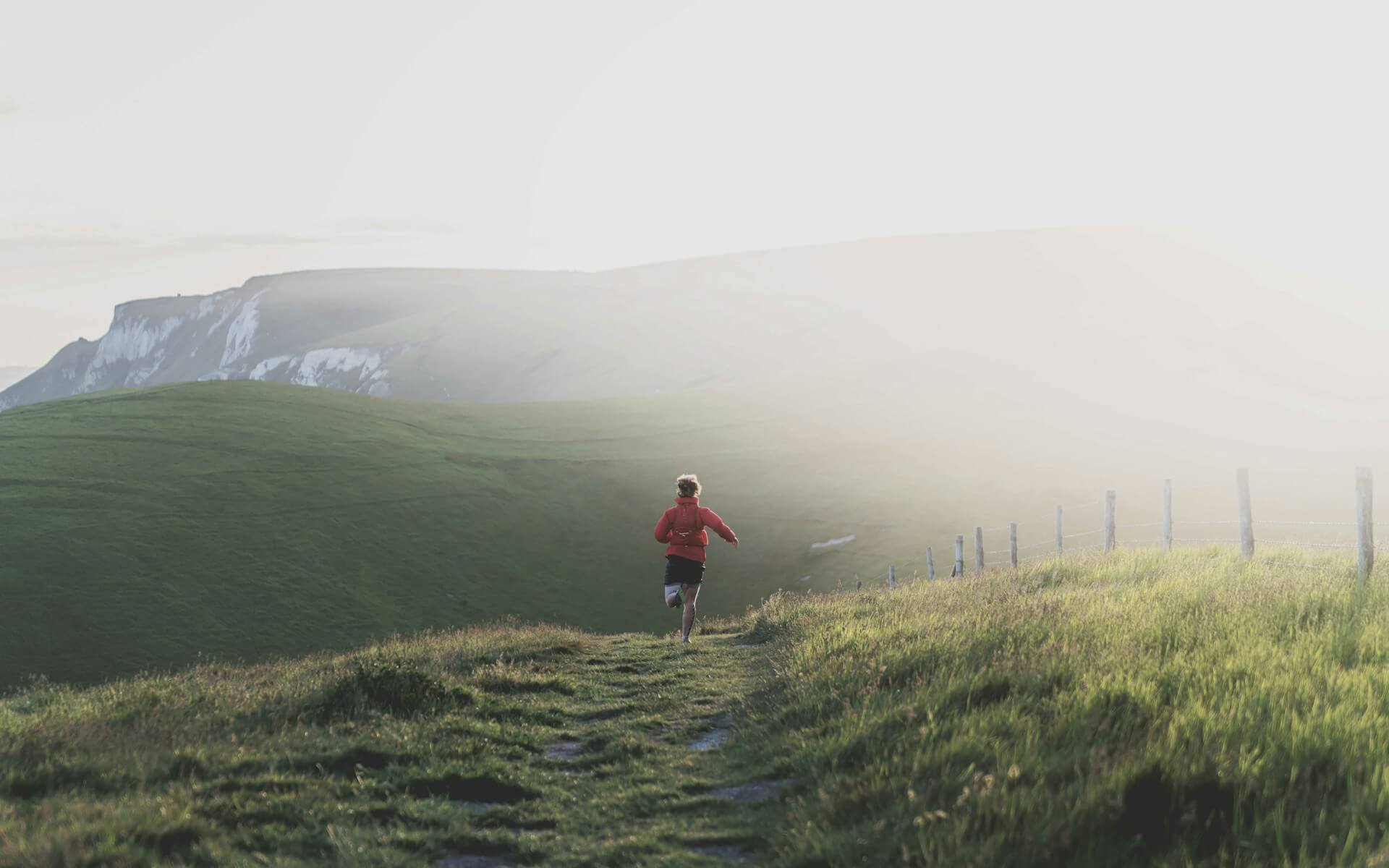
Photo : Unsplash
The forest is good for you
Running in nature isn’t just more fun. It’s also better for your lungs. In the city, you breathe in pollution. In Paris, fine particle levels regularly exceed WHO recommendations, with peaks of 25-35 µg/m³ on busy days. These particles penetrate deep into the lungs and bloodstream. An urban runner inhales more air than someone at rest, and therefore more pollutants. On a 10 km run in the city during rush hour, your lungs take a serious beating.
In the forest, the opposite is true. Fine particle levels fall to less than 5 µg/m³, five to seven times lower than in the city. Trees filter the air, capture pollutants and produce oxygen. Every breath is cleaner and healthier. Lungs work better, recovery is better.
Even better: trees emit molecules called phytoncides, volatile organic compounds that boost the immune system. Japanese studies have shown that these molecules increase the activity of NK (Natural Killer) cells, which protect against infection and disease. In short: breathing in the forest makes you more resistant. No need for dietary supplements, just go for a run outside!
It’s no coincidence that the Japanese – recently imitated by the Scots and Canadians – have been prescribing nature outings on medical prescription since the 1980s. They’ve even coined a term for it: shinrin-yoku, “forest bathing”. Studies show that 20 minutes in the forest reduces cortisol, the stress hormone, by 12% to 16%. No need to run fast, no need to perform. Just be in the forest, move and breathe.
Adventure vs. routine
Running 10 km in town is often repetitive: you know where the next traffic light is, the next bend, the next straight stretch. In nature, every outing is different. The light changes according to the time of day, the season. You may spot a rabbit around a bend, come across a clearing you’ve never seen before, discover a new viewpoint.
These moments of wonder bring real benefits, including increased feelings of generosity, well-being and humility, according to a study conducted by the University of San Francisco. Other research conducted by the University of California at Berkeley has shown that regularly experiencing wonder could help reduce inflammation. We’ll take it!
When you’re running in the wilderness, you never know exactly what you’re in for. Not in the “danger” sense, but in the “positive surprise” sense. Maybe that’s why trail runners often talk more about their outings with anecdotes than with times and Strava stats. In the city, we talk about time per kilometer. In nature, we talk about what we experienced.
Photo : Unsplash
It’s more accessible than you think
“Yes, but I’m a beginner, I’ll get lost.” “Yes, but you need technical equipment.” “Yes, but it’s for warriors who do ultras.” No, no, and no. Trail running is for everyone. You don’t need to be an athlete, you don’t need 400-euro shoes, you don’t need an ultra-sophisticated GPS. Just soles with a bit of grip, a trail and the desire to go for it.
For beginners: start with short, well-marked trails. The Alpes Mancelles region, where the Bon Air Club welcomes you, offers dozens of signposted loops with gentle gradients, perfect for discovering nature trail running without getting into difficulty. No cliffs, no exposed sections, just relief to exercise your legs without unnecessary stress.
For those who are reluctant to take the plunge: nature trail running is not a compulsory skills upgrade. It’s not a case of “first the city, then nature when I’m ready”. It’s just a choice. Just try it once. On a Saturday morning, take the car, train or bus, go an hour away from home, find a trail, run for 45 minutes. You’ll see the difference! And you’ll understand why nature runners swear by it.
At the Bon Air Club, we welcome all profiles. Those who have never run outside their neighborhood, those who are hesitant, those who just want to try it. We offer guided outings, adapted routes – including a 1 km mini-trail to start with – and non-judgmental advice. Because trail running is not for the elite. It’s just another way of running. And in our opinion, it makes you happier.